
Mycelarium Automation: Self-Running Colonies
Turn a Mycelarium colony into a self-running loop: food production, water supply, automatic defence and the clicks you can safely stop making.
Mycelarium is an incremental game, but it never builds for you. Automation here means arranging mushrooms and upgrades so the colony keeps producing while you explore: food arrives without hunting, water refills without shuttling, and defences fire without a click. The goal is not a factory that plays itself; it is a network that does not collapse when you look away.
This guide covers the three loops that matter, the upgrades that make them stable, and the parts of the game that cannot be automated.
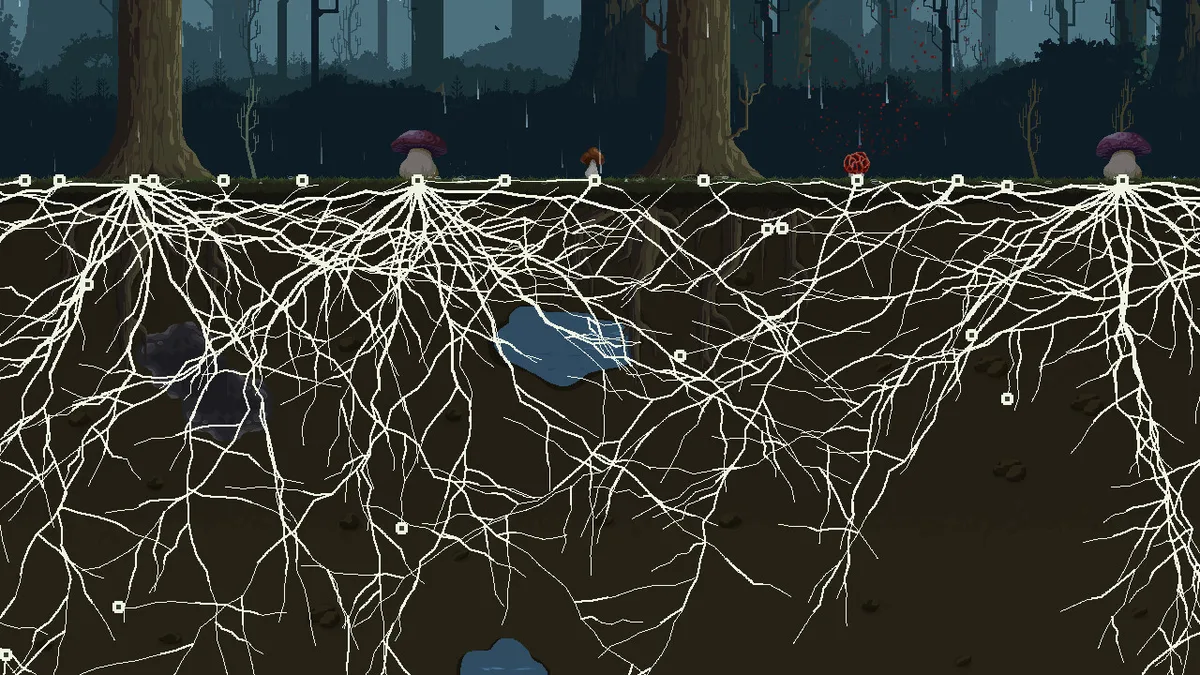
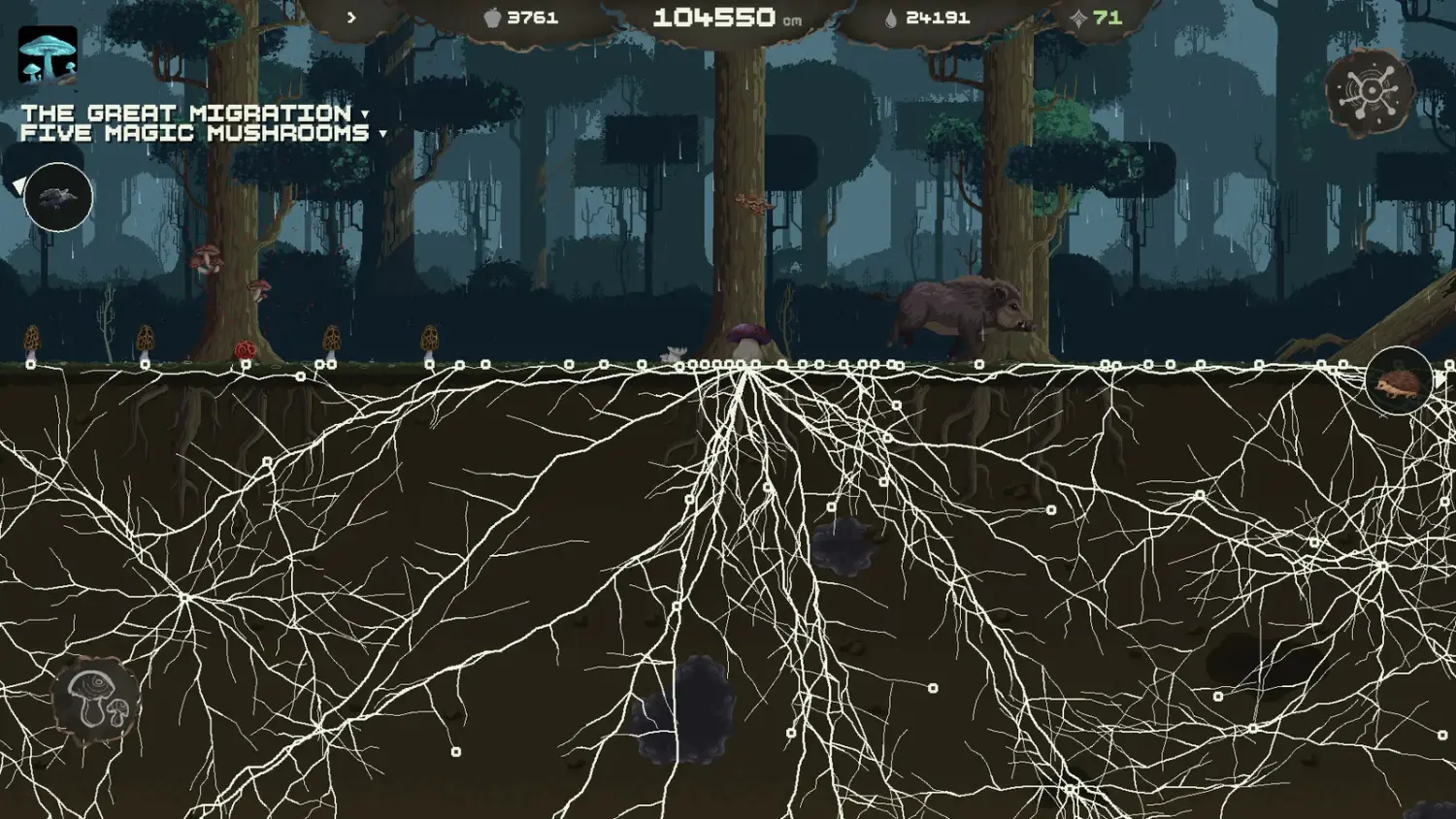
The three loops
A stable colony runs three loops at once:
- Food loop — Absorber or Predator produces food faster than you spend it on structures.
- Water loop — connected pools plus a Water Mushroom cover the cost of growth.
- Defence loop — Stinky coverage plus Repeller Auto Regen keeps animals off the producers.
Each loop has a failure mode. Food runs out when you build too fast; water runs out when you grow too far from a pool; defence fails when a Repeller is on cooldown and a Stinky does not cover the approach. Automation is the art of closing all three before they open.
Building the food loop
The earliest stable loop is Absorber plus leaf litter. It needs no animals, no travel and no attention. Add a Predator Mushroom when you need a larger surplus, and place it inside the defended zone.
The loop is stable when the food counter rises while you are doing something else. A useful test: stop building for two minutes and watch the counter. If it climbs, the loop works. If it is flat, you have exactly enough production for your current spending and no reserve.
For a larger colony, the loop becomes Predator clusters plus a Consumptor tree. The Predators smooth the income; the tree provides the lump sums for big projects. The food guide→ ranks the sources by phase.
Building the water loop
Water is harder to automate because pools are finite. The loop has two parts:
- Storage: connect every pool you pass, even if you do not need it yet.
- Production: build a Water Mushroom once the network outgrows the pools.
Water Yield and Drop Rate turn the mushroom into a tap. With both upgraded, a deep branch can grow without returning to a reservoir. That is the point where water stops being a constraint and becomes a background number.
Rain is the free accelerator. Keep a list of long connections and make them during the storm. The water guide→ explains the pool economy in detail.
A producer that gets eaten is not production. Buy Repeller Auto Regen before Predator Yield if animals are active on your map.
Building the defence loop
The defence loop is the simplest to automate and the easiest to neglect:
- One Stinky covers the cluster.
- One Repeller faces the approach.
- Auto Regen keeps the Repeller firing.
- The animal tracker tells you when a new approach appears.
Once those four are true, you can leave the base for long enough to explore. The animals guide→ has the two-tree layout that players report working.
What can't be automated?
- Growth. You still choose where the network goes. There is no auto-grow upgrade in the visible tree.
- Building. Mushrooms are placed manually. The 1–8 shortcuts reduce the clicks, not the decision.
- Spore targeting. Spores are aimed manually, and a bad landing is expensive.
- Upgrade choices. Points are spent manually, and there is no respec.
The game's idle layer is production, not decision-making. That is why the upgrades that matter are the ones that remove chores: Auto Regen, Absorption, Water Yield. They give you more time for the decisions.
What does a mature colony look like?
A mature Mycelarium colony has:
- Multiple Predator Mushrooms inside a defended perimeter.
- At least one Water Mushroom with both branches.
- A Stinky covering each cluster and a Repeller on each approach.
- A Consumptor tree for lump-sum food.
- A network dense enough that a single lost mushroom is not a crisis.
At that point, the limiting factor is map distance, not income. Spores and penetration become the interesting purchases.
How do you know a loop is failing?
Three signals:
- Food flat while building. Production equals spending; add a source before the next project.
- Water falling during short shots. Efficiency is too low or the nearest pool is too far; fix one of them.
- Mushrooms disappearing at the frontier. Defence is not covering the asset; move the Stinky or add a Repeller.
Fix the loop before adding a new mushroom. A fourth producer on a broken loop just makes the failure more expensive.
FAQ
Is there an idle mode?
No. Production continues while you explore, but growth and building are manual.
How many Predators do I need?
Enough that food rises while you are away from the base. The achievements expect 20 and 100 for the factory milestones, but a normal run needs far fewer.
Do Water Mushrooms run out?
They produce continuously. The branch upgrades increase the amount and frequency.
Can defence run forever?
With Auto Regen and enough food/water income, a Repeller can keep firing indefinitely. The Stinky is passive and needs no upkeep while it lives.
Official source: Mycelarium on Steam ↗ Official source: Update 1.02 notes ↗
The Steam discussions hub ↗ has player descriptions of production loops; the achievement page ↗ shows how many players scale to 20 and 100 Predator Mushrooms.